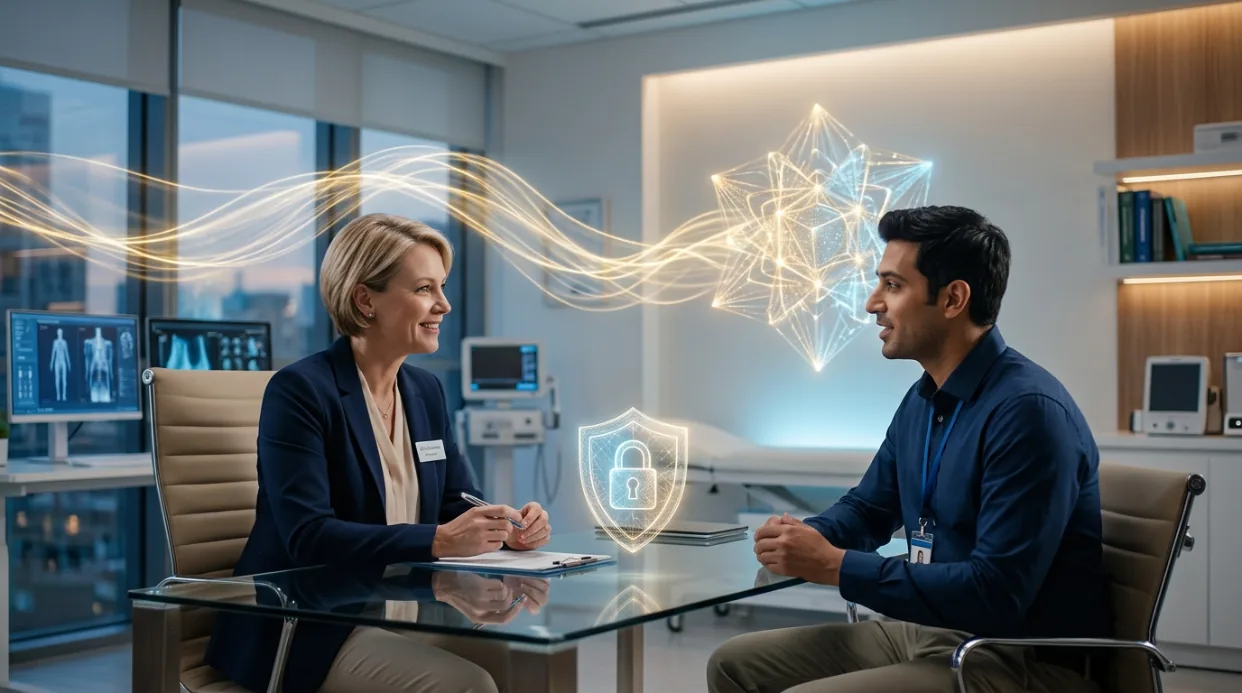
Ambient AI in medical affairs means capturing a scientific conversation as it happens and structuring it, rather than reconstructing it from memory afterwards. The term arrived from clinical documentation, where the problem is different in ways that matter — particularly around consent.
Most people in pharmaceutical medical affairs first encountered "ambient AI" through healthcare rather than through their own function. Clinical ambient scribes — systems that listen to a consultation and draft the clinical note — became widely discussed, and the category name travelled with them.
That inheritance is useful, because it means the concept needs no introduction. It is also misleading, because the medical affairs problem differs from the clinical one in three respects, and each difference changes the design.
Key takeaways
Ambient AI in medical affairs means capturing a scientific interaction as it happens and structuring it, rather than writing it up afterwards from memoryThe clinical ambient scribe analogy breaks down because the relationship, the record and the consent basis are all differentAmbient capture produces structure — coverage, insights, follow-up actions — not just a transcript. A transcript alone solves almost nothingRecording consent has to be captured per meeting and enforced in the application, which means the system must work fully when consent is declinedAmbient capture cannot judge whether a scientific position was correct, and should not be described as though it can
Where did the term come from?
Ambient documentation began in clinical settings as a response to a specific, well-documented burden: clinicians spending substantial time writing notes rather than seeing patients. The design goal was narrow — produce an accurate clinical note from a consultation without the clinician typing during it.
The category worked because the problem was clear, the output was defined, and the person being recorded was in an established relationship with the person doing the recording.
Medical affairs teams looked at that and recognised something familiar. An MSL also documents interactions afterwards, also loses detail to memory, and also spends evenings on write-ups. The surface similarity is real, and ambient capture, defined as a term in this field, borrows directly from it.
Why doesn't the clinical scribe model transfer?
Three differences, in increasing order of importance.
The record is not the point. A clinical note is the deliverable — it is the thing that has to exist, and accuracy of transcription is most of the value. In medical affairs, the transcript is an input. Nobody in a medical function needs a verbatim record of a conversation; they need to know what science was covered, what the HCP raised, and what to do next. A system that produces an excellent transcript and nothing else has automated the least valuable part.
The relationship is peer-to-peer, and external. A clinician documenting a consultation is recording an interaction within their own duty of care. An MSL is recording a conversation with an independent professional who does not work for the company, has no obligation to participate, and may reasonably not want a scientific discussion — particularly one where they are being critical — captured by a pharmaceutical company's system.
Consent is not administrative. In the clinical setting, consent to ambient documentation is usually handled once, at the level of the practice or institution. In medical affairs it cannot be, because each HCP is an independent party and each conversation is a separate event. This is the difference that most affects the design, and it is the subject of the next section.
What does ambient capture actually produce?
If a transcript is the input rather than the output, the useful question is what gets built from it.
Structure, first. Which planned scientific talking points were substantively discussed, which were mentioned in passing, and which were not reached. That is a factual account of the conversation against what the medical team intended to cover.
Typed insights. What the HCP contributed, sorted into categories that mean something operationally — unmet need, evidence gap, treatment barrier, clinical question — rather than a paragraph of free text nobody reads.
Routing signals. Adverse events, product quality complaints, off-label questions and medical information requests identified and passed into the organisation's own processes, on its own timelines.
A position, not just an event. The HCP's understanding of a product and a communication topic, updated. This is the part that compounds, and it is why what gets measured from a captured conversation matters more than the fidelity of the recording.
A transcript alone delivers none of these. It relocates the problem from writing the note to reading the transcript.
Why is consent a design decision rather than a checkbox?
Because the answer determines what the rest of the system can assume.
If a platform treats meeting recording consent in pharma as a compliance formality — a box ticked before the useful part starts — then declining consent breaks it. The measurement stops, the insight capture stops, and the interaction becomes invisible to the system. In practice that means the platform quietly measures consent rates, and the field team learns that non-consented meetings are worth less to report.
The alternative is to design for refusal from the start. Consent is requested for each meeting, not once for a relationship. If it is declined, no audio is captured and nothing is transmitted anywhere. The MSL completes a structured record instead — the same fields, the same insight types, the same coverage assessment, entered by hand rather than derived.
That path is less convenient and it has to exist, because a meaningful proportion of scientific interactions will never be recorded. Some HCPs decline. Some settings make it impractical. Some organisations' own rules prohibit it. A system that only functions with audio is not a measurement system; it is a recording system with a measurement feature.
Details of what is retained and for how long belong in our privacy policy rather than in an article, and any vendor should be able to point you to an equivalent document rather than describing it verbally.
What ambient capture cannot do
Three limits worth stating, because the category is currently being oversold.
It cannot judge whether the science was right. A system can establish that a topic was discussed and that an HCP raised an objection. Whether the MSL's response was scientifically sound is a clinical judgement, and any product claiming to assess that is claiming more than it can support.
It cannot read a room. Tone, hesitation and the difference between polite agreement and genuine persuasion are visible to the person in the conversation and largely invisible to a model. This is part of why sentiment belongs in a profile as context and not in a score.
It cannot substitute for the MSL's judgement about what to raise. Preparation can assemble the relevant science; deciding which point matters for this clinician, today, in the time available, is the part of the job that is not automatable.
Those limits are not temporary gaps waiting on a better model. They are the boundary of what the approach can do, and a vendor who does not volunteer them is worth asking about — which is roughly what the eleven questions to ask a vendor are for.